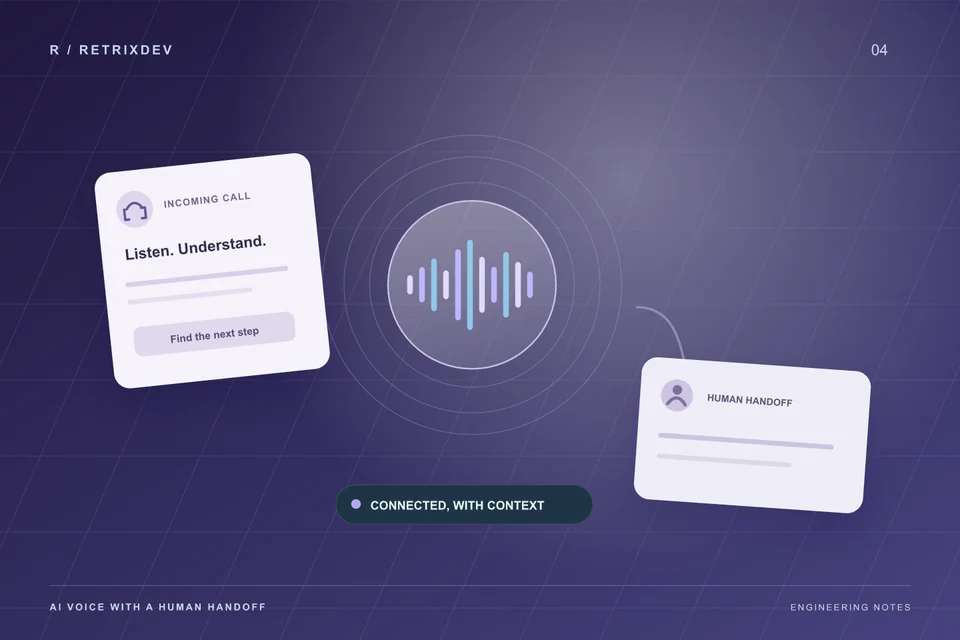
The interesting part is not whether an AI can answer a call. It is whether the caller reaches the right outcome when a conversation becomes difficult.
A useful AI receptionist needs a limited job, approved business information, reliable integrations and a clear human handoff. Test those together before routing real customers to it.
Choose one job for the first version
Start with a specific outcome: collect a callback request, answer opening-hours questions, qualify an enquiry or request an appointment. Combining every possible business conversation into one initial agent makes failures harder to understand.
Write down what the agent is allowed to say and what it must refer to a person. Pricing exceptions, refunds, emergencies and disputes may require a different route. The correct boundary depends on the business and the callers it serves.
Map the call before writing a prompt
Sketch the greeting, caller intent, information needed, confirmation step and final action. Include interruptions and corrections. A caller may change their requested date halfway through a booking or ask to speak to a person immediately.
Build an explicit fallback for silence, poor audio, unsupported language and an unavailable integration. Decide whether the agent transfers a call, offers a callback or records a request. The fallback should help the caller continue without pretending an action succeeded.
Connect real systems carefully
A booking agent needs to read actual availability and confirm whether a booking was created. A lead agent needs to know whether the CRM accepted the record. Treat a successful API response and a plausible spoken sentence as separate things.
- Use identifiers to prevent duplicate bookings or leads on retries.
- Limit integration permissions to the actions the agent needs.
- Confirm important details with the caller before committing an action.
- Record enough operational detail to investigate a failed handoff.
The system should distinguish “I have sent your request” from “your appointment is confirmed.” That small wording choice prevents a large operational misunderstanding.
Decide what information is collected
Collect only the information needed for the task. Explain the use of an automated assistant and apply the recording, consent and privacy rules relevant to the callers and business. Avoid keeping call recordings indefinitely by default.
Document which telephony, speech, model and integration providers process call data. Agree on access, retention and deletion before launch. Sensitive use cases require a more specific review than a general enquiry line.
Test conversations that do not go to plan
Create a test set with accents, background noise, incorrect details, interrupted speech, repeated questions and requests outside the agent’s scope. Test what happens when a calendar or CRM is unavailable. Check the result in the connected system as well as listening to the call.
Track useful measures such as completed requests, successful transfers, duplicate actions and situations requiring correction. Do not judge the agent only by how natural one demonstration sounds.
Separate setup from running cost
Ongoing costs can include a phone number, call minutes, speech processing, model usage and integration hosting. Calculate an expected range using real call duration and volume, then measure it during a limited rollout. Provider prices and supported features can change.
RETRIXDEV offers AI integration and calling-agent setup. Share your current call flow, business tools and the point at which a person should take over, and we can help scope an initial implementation.

Full-stack developer and Linux system administrator at RETRIXDEV. Working across web applications, mobile apps, integrations and deployment.
About Lokesh Nain ↗